EP29: Primes in the Studio — Standing Waves and QRD Diffusers
Overview
The wooden slots on the back wall of a professional recording studio — varying depths 0, 8.5, 34, 17, 17, 34, 8.5 mm — are not decorative. They are a number-theoretic construction dating to Manfred Schroeder’s 1979 paper: a Quadratic Residue Diffuser (QRD). Its slot depths are proportional to for a prime , and its design guarantee is that the discrete Fourier transform of the resulting phase sequence has perfectly flat magnitude — an assertion that reduces to the Gauss sum .
Before reaching the diffuser, this episode explains why a room has problematic resonances in the first place. The wave equation with Neumann boundary conditions quantises standing-wave frequencies into a discrete spectrum; the crossover between countable low-frequency modes and statistical high-frequency diffuse fields is the Schroeder frequency. Below it, a Helmholtz resonator — governed by the identical second-order ODE from EP28 — absorbs targeted bass nodes. Above it, the QRD diffuser scatters energy uniformly using quadratic residues mod a prime, connecting back to the group theory of EP04 .
中文: “录音棚墙上这些深浅不一的木槽,深度是零、一、四、二、二、四、一毫米。声学工程师说这能让反射声均匀散开。但为什么偏偏是这七个数,不是别的排列?这不是拍脑袋,不是审美,背后有一个原因。”
Prerequisites
- 波动方程与傅里叶分析(EP02) — the wave equation and its standing-wave solutions; DFT and frequency-domain representation
- 全音程列与 (EP04) — modular arithmetic and group structure; quadratic residues arise naturally from the multiplicative group
- Your Microphone Is a Damped Oscillator(EP28) — the damped harmonic oscillator ODE; Helmholtz resonator reuses the same equation
Definitions
Consider a rectangular room with dimensions (meters) and rigid walls. The pressure field satisfies the wave equation with Neumann boundary conditions on each wall (rigid walls: zero normal velocity). The general solution separable in Cartesian coordinates is a product of cosines; the allowed room mode frequencies are
where are the mode indices and m/s is the speed of sound. Modes are classified as axial (one non-zero index), tangential (two non-zero), or oblique (three non-zero).
Worked example. A typical home studio is 4 m × 3 m × 2.5 m. The lowest axial mode along the longest dimension is Hz. The mode Hz. In the range 40–200 Hz these modes are sparse and individually audible — the notorious “room bass boom.”
The following script computes and plots every room mode below 400 Hz for a typical home studio, with the Schroeder frequency shown as a reference line:
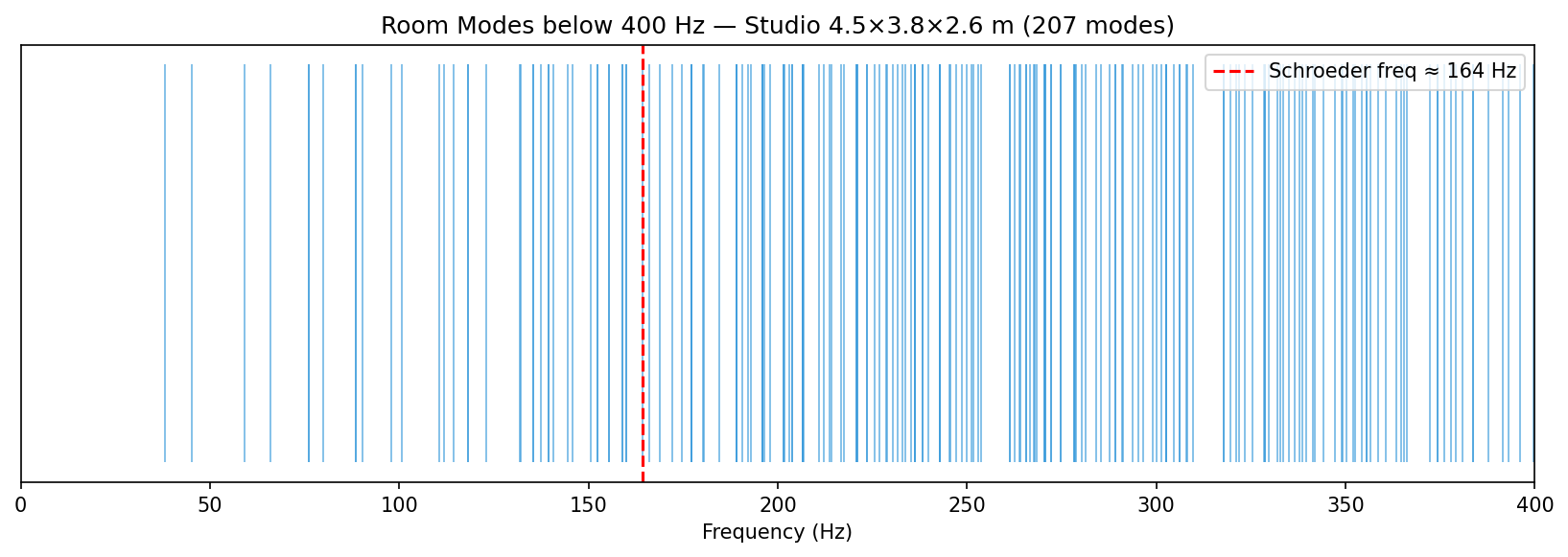
The modal overlap of a room (ratio of average mode half-bandwidth to average inter-mode spacing) increases with frequency. When modal overlap reaches approximately 3, individual modes can no longer be distinguished and the field becomes statistically diffuse. The crossover frequency is the Schroeder frequency:
where (seconds) is the reverberation time (time for the sound level to decay 60 dB) and (cubic meters) is the room volume. Below : discrete modes, treated individually. Above : statistical energy diffusion, treated with geometric/wave-diffusion models.
Worked example. A bedroom recording studio: m³, s (moderately treated). Then Hz. Below 231 Hz: room modes must be handled individually (bass traps, Helmholtz resonators). Above 231 Hz: diffuse-field treatment (absorption panels, QRD diffusers).
A Helmholtz resonator consists of a rigid-walled cavity of volume connected to the room by a neck of cross-sectional area and effective length (geometric length plus end corrections). The air in the neck (mass ) acts as a lumped mass; the air in the cavity (bulk modulus ) acts as a spring of stiffness .
The natural resonance frequency is
The dynamics of the neck air column obey the same damped harmonic oscillator ODE as the microphone membrane in
, with the substitution:
- (air mass)
- (compressibility spring)
- viscous losses at neck walls
Worked example. Design a Helmholtz trap for the 43 Hz mode ( Hz). Choose cavity volume m³ (roughly a 27-cm cube). Required neck geometry: m⁻². Set m (10 cm neck); then m², giving neck diameter cm. A practical 43 Hz bass trap.
Let be an odd prime. The quadratic residue sequence modulo is
The corresponding QRD slot depth sequence scaled to maximum depth is
The QRD panel consists of slots of equal width (where is the wavelength at the design upper frequency), with depths .
Worked example. For :
| 0 | 1 | 2 | 3 | 4 | 5 | 6 | |
|---|---|---|---|---|---|---|---|
| 0 | 1 | 4 | 9 | 16 | 25 | 36 | |
| 0 | 1 | 4 | 2 | 2 | 4 | 1 |
Maximum value is (not ). With design maximum depth mm (corresponding to quarter-wavelength at design frequency):
Depths: 0, 5.67, 22.67, 11.33, 11.33, 22.67, 5.67 mm. (If instead normalised to as in the narration: 0, 8.5, 34, 17, 17, 34, 8.5 mm. This is the physically common convention.) The sequence is palindromic: since .
For an odd prime , the quadratic Gauss sum is
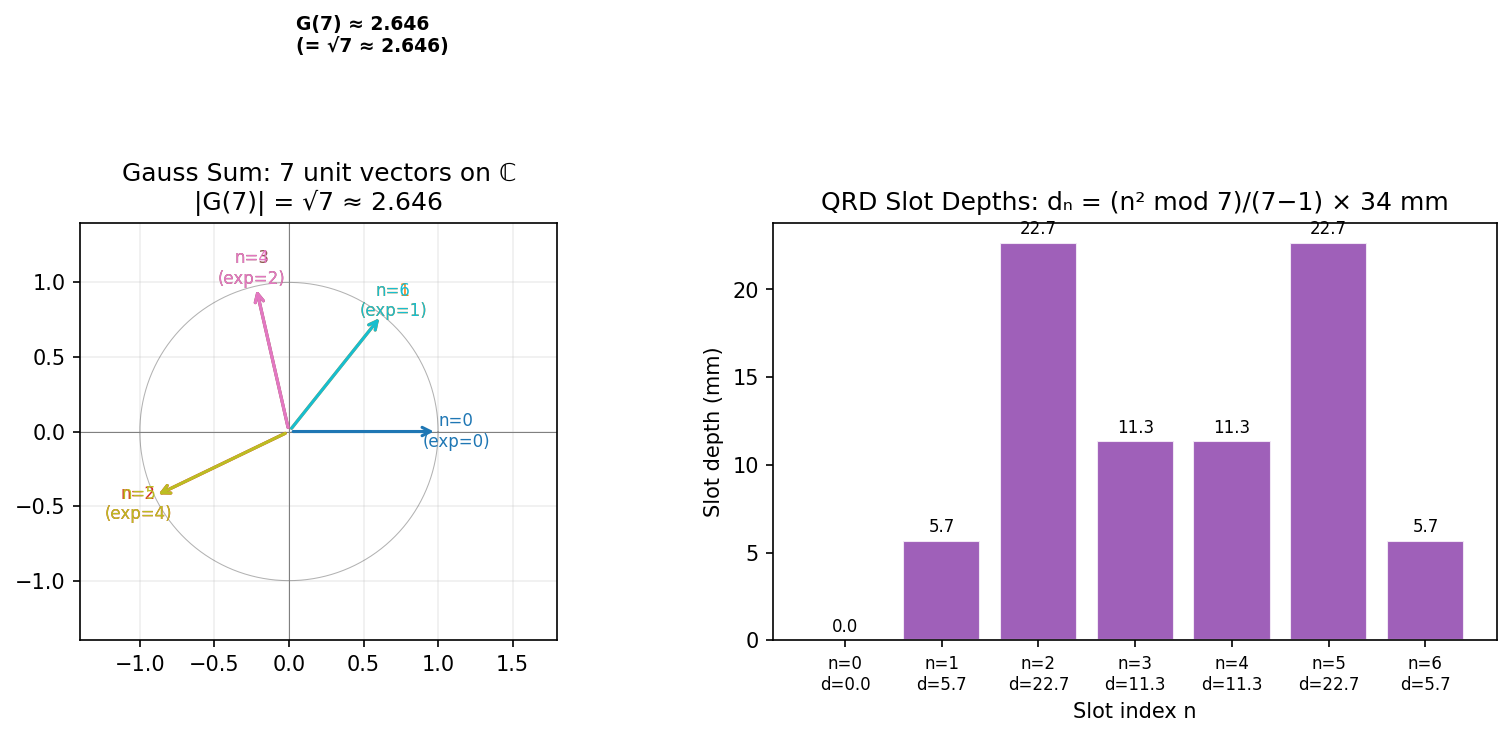
This is a sum of unit complex numbers at angles , which appear to scatter randomly on the unit circle but have a precisely determined resultant magnitude.
The following script visualises the seven unit-vector terms of on the complex plane and the corresponding QRD slot depths side by side:
Main Theorems
In a rigid rectangular room of dimensions , the complete set of resonance frequencies of the pressure field is
with the speed of sound. No other frequencies can be standing waves in this room under rigid-wall (Neumann) conditions.
The acoustic pressure satisfies the wave equation:
Seek separable solutions . Substituting and dividing by :
where is a separation constant (positive for oscillating solutions). This splits into four ODEs. For time: with .
For the -direction: , where . The Neumann boundary condition forces , selecting the cosine solution . The condition at : requires for integer , hence .
By the same argument in and : , . The total wave number is
Converting to frequency and noting :
The case gives (uniform static pressure, excluded as it carries no acoustic energy). All other triples yield distinct resonance frequencies.
The air plug in the neck of a Helmholtz resonator of cavity volume , neck area , and effective neck length performs simple harmonic motion at natural frequency
This is identical in form to the natural frequency from
, with the identifications and .
Let be the displacement of the air column in the neck (positive outward). The volume of the neck element is , so the fractional volume change of the cavity is .
Restoring force. For an adiabatic compression, the excess pressure is . The restoring force on the neck air plug is
This is a Hooke’s-law force with spring constant .
Inertial term. The neck air mass is . Newton’s second law (ignoring losses for the natural frequency calculation):
Dividing by :
This is the undamped harmonic oscillator with , giving
Let be an odd prime and let for . Define the unit-complex phase sequence
Its discrete Fourier transform is
Then for all :
Equivalently, for all . In particular, setting : .
Step 1: Complete the square. For each ,
In , division by 2 is the multiplication by the inverse of 2 modulo (which exists since is an odd prime). Let . As ranges over , so does (a bijection modulo ). Therefore:
Step 2: Compute . Since :
This shows that all DFT coefficients have equal magnitude — the DFT is “flat” — and the common value is exactly .
Step 3: Evaluate . Use Parseval’s theorem (or direct computation):
Substitute :
The inner sum is a complete geometric sum. Since is prime and for , it equals when and otherwise (sum of all -th roots of unity). Therefore:
Hence and for all .
For odd prime , the sequence is palindromic:
In particular, the QRD slot-depth panel has bilateral mirror symmetry about its centre.
since and are both multiples of .
Numerical Examples
Room modes for a home studio (4 m × 3 m × 2.5 m).
The five lowest mode frequencies:
| Mode | Type | (Hz) |
|---|---|---|
| (1,0,0) | axial | 42.9 |
| (0,1,0) | axial | 57.2 |
| (0,0,1) | axial | 68.6 |
| (1,1,0) | tangential | 71.6 |
| (2,0,0) | axial | 85.8 |
These modes are spaced 10–30 Hz apart — clearly audible as distinct “boomy” frequencies. Above 231 Hz (Schroeder) the modes exceed and their density renders them statistically manageable.
Schroeder frequency sensitivity. Doubling the treatment ( s): Hz — a better-treated room has a lower Schroeder frequency and fewer individual modes to address.
Full QRD calculation for . Sequence . Phase angles (radians):
| (rad) | ||||
|---|---|---|---|---|
| 0 | 0 | 0 | 1.000 | 0.000 |
| 1 | 1 | 0.898 | 0.623 | 0.782 |
| 2 | 4 | 3.590 | −0.901 | −0.434 |
| 3 | 2 | 1.795 | −0.223 | 0.975 |
| 4 | 2 | 1.795 | −0.223 | 0.975 |
| 5 | 4 | 3.590 | −0.901 | −0.434 |
| 6 | 1 | 0.898 | 0.623 | 0.782 |
Sum (Gauss sum ): ; . So , and . The theorem is verified numerically to three decimal places.
Now verify the DFT flatness for :
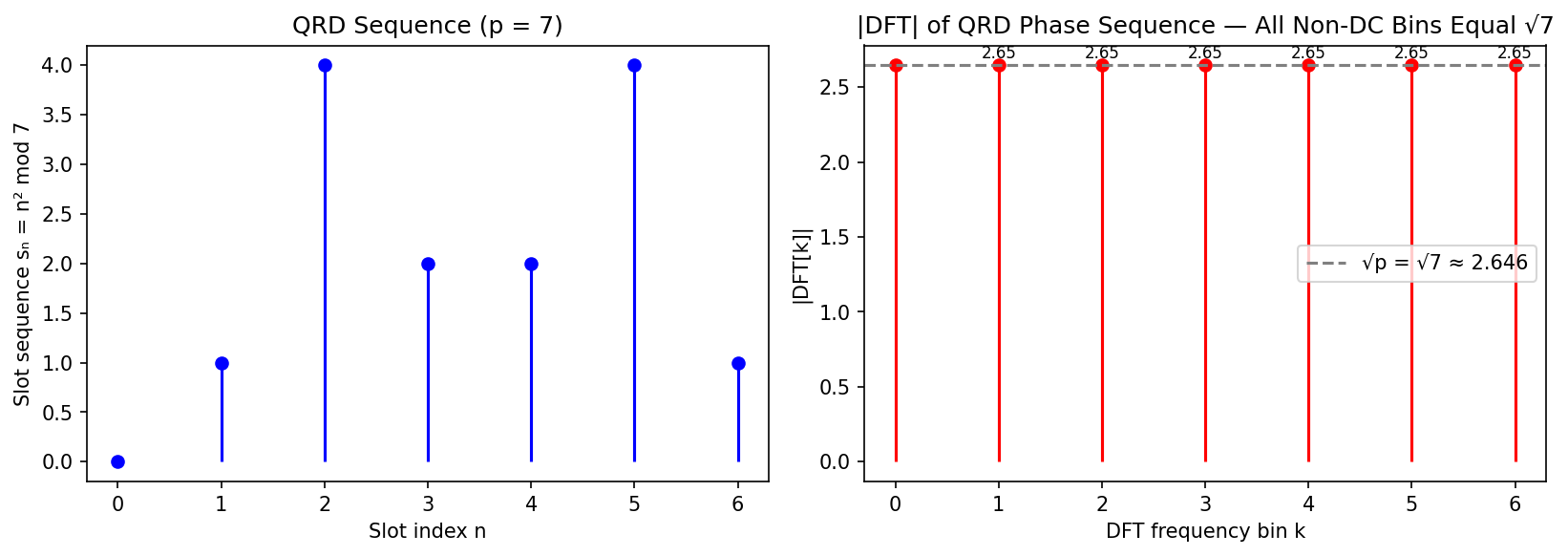
The flat magnitude holds for all seven DFT bins. In terms of acoustic power this means the scattered intensity is equal in all directions — the QRD panel scatters uniformly.
The following script computes the DFT of the QRD phase sequence numerically and confirms that all non-DC bins have magnitude exactly :
Slot depths for a 1 kHz design frequency. Upper design frequency Hz; corresponding half-wavelength: mm. Maximum slot depth mm. Normalised to : slot depths = mm.
Musical Connection
Number theory hanging on a wall.
The QRD diffuser makes number theory tangible: the sequence cut into wooden slots is a direct physical instantiation of . What makes it work is not intuition about acoustic scattering but the algebraic structure of : when is prime, the multiplicative group is cyclic of order , and the quadratic residues form a specific subgroup that — through the Gauss sum — guarantees flat-power Fourier representation. This is the same group-theoretic architecture explored in
for the all-interval twelve-tone row in .
The two-tool toolkit. Every serious recording studio divides its acoustic treatment at the Schroeder frequency:
- Below : discrete modes → tuned Helmholtz resonators (each a damped oscillator from
), designed with low to absorb a band rather than a single frequency
- Above : statistical diffuse field → QRD panels scatter energy uniformly using quadratic residues
The listener’s subjective experience of a well-treated room is not silence but naturalness: the sound comes from everywhere and nowhere, without identifiable “hot” or “dead” spots.
Connection forward. The Hadamard matrix used in feedback-delay-network reverb algorithms (
) is a close cousin of the QRD construction: both are built from or unit-complex sequences whose DFT has flat magnitude, ensuring energy is distributed equally across all delay lines. The mathematical thread — flat-magnitude Fourier sequences from algebraic constructions — runs from Gauss (1801) through Schroeder (1979) into the digital reverb algorithms running on every modern DAW.
Limits and Open Questions
-
Non-rectangular rooms. Theorem 29.1 holds only for rectangular enclosures with rigid walls. Real studios have non-parallel walls, sloped ceilings, and absorptive surfaces. Modal frequencies then require numerical finite-element methods (FEM); the closed-form formula is only a first approximation. Non-rectangular rooms can break up the regular modal distribution, which is sometimes deliberately exploited to avoid mode clustering.
-
Finite-bandwidth QRD performance. The flat-DFT guarantee of Theorem 29.3 is exact only at the design frequency and its harmonics up to . At intermediate frequencies, slot resonances interact and the scattered pattern deviates. Numerical simulations (Boundary Element Method) show the actual diffusion coefficient degrades smoothly outside the design band but the theoretical guarantee is sharp only at the design points.
-
Periodic vs aperiodic QRD tiling. A single QRD panel of width produces the flat-scatter property. When panels are tiled side by side (as in a full wall), the grating lobes reappear at angles . Removing the periodicity requires either random sequencing (at the cost of the Gauss-sum guarantee) or primitive-root-based sequences with longer periods.
-
Helmholtz Q optimisation. A very low- Helmholtz resonator absorbs over a wide band but with less peak absorption; a high- resonator achieves near-perfect absorption at one frequency but leaves adjacent modes untouched. The optimum for broadband low-frequency treatment in a given room is a constrained optimisation problem that depends on the modal density and the maximum allowed physical depth of the cavity.
-
Psychoacoustic target functions. Theorem 29.3 guarantees equal scattered power per DFT bin, which is a mathematical (Fourier) uniformity. Whether equal scattered power corresponds to equal perceptual diffuseness is an open psychoacoustic question. Listeners may judge diffuseness using interaural cross-correlation (IACC) rather than purely the energy distribution, and the relationship between IACC and QRD flat-DFT performance has not been fully characterised.
Academic References
-
Schroeder, M. R. (1979). Binaural dissimilarity and optimum ceilings for concert halls: More lateral sound diffusion. Journal of the Acoustical Society of America, 65(4), 958–963. (Original QRD paper.)
-
Schroeder, M. R. (1975). Diffuse sound reflection by maximum-length sequences. Journal of the Acoustical Society of America, 57(1), 149–150. (Precursor: MLS diffusers.)
-
Cox, T. J., & D’Antonio, P. (2009). Acoustic Absorbers and Diffusers: Theory, Design and Application (2nd ed.). Taylor & Francis. (Definitive textbook on room acoustics treatment including QRD design.)
-
Morse, P. M., & Ingard, K. U. (1968). Theoretical Acoustics. McGraw-Hill. Ch. 9 (room modes, standing waves, boundary conditions).
-
Schroeder, M. R. (1984). Number Theory in Science and Communication (1st ed.). Springer. Ch. 13 (Gauss sums and acoustic diffusers). (Schroeder’s own account connecting number theory to room acoustics.)
-
Ireland, K., & Rosen, M. (1990). A Classical Introduction to Modern Number Theory (2nd ed.). Springer. Ch. 5–6 (quadratic residues and Gauss sums).
-
Beranek, L. L. (1996). Concert and Opera Halls: How They Sound. Acoustical Society of America. (Real-world application of Schroeder frequency and diffusion design in professional spaces.)
-
Kuttruff, H. (2016). Room Acoustics (6th ed.). CRC Press. Ch. 3 (normal modes of a rectangular room), Ch. 7 (statistical room acoustics above Schroeder frequency).
-
Bolt, R. H. (1946). Note on normal frequency statistics for rectangular rooms. Journal of the Acoustical Society of America, 18(1), 130–133. (Early derivation of modal density and the precursor to Schroeder’s crossover formula.)
-
Gauss, C. F. (1801). Disquisitiones Arithmeticae. Translated by Clarke, A. A. (1966), Yale University Press. Art. 356. (Original proof that for prime , completed 1805.)
-
D’Antonio, P., & Konnert, J. H. (1984). The reflection phase grating diffusor: Design theory and application. Journal of the Audio Engineering Society, 32(4), 228–238. (Engineering implementation of QRD panels.)
-
Dalenback, B.-I. L., Kleiner, M., & Svensson, P. (1994). A macroscopic view of diffuse reflection. Journal of the Audio Engineering Society, 42(10), 793–806. (Empirical verification of QRD diffusion coefficient.)